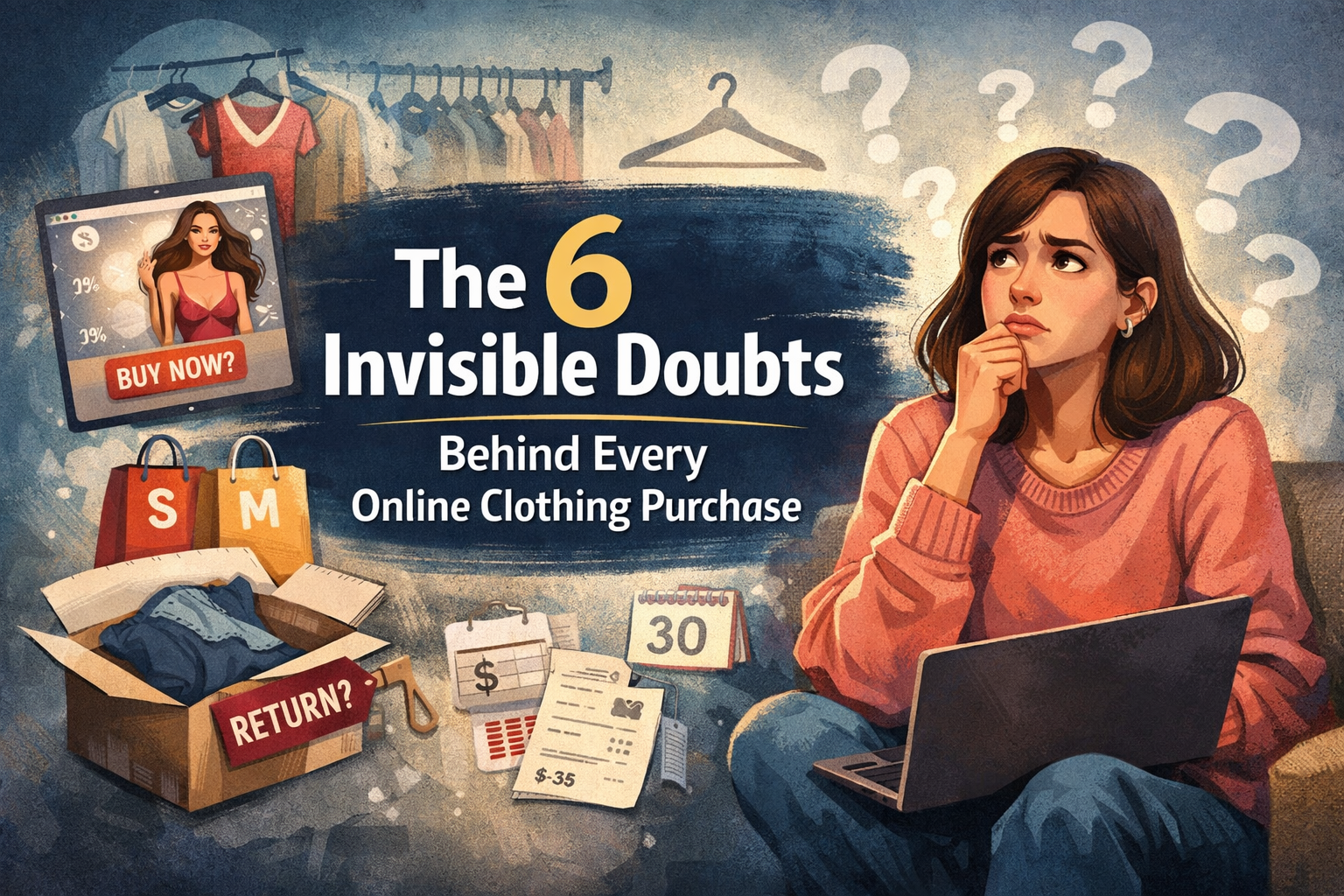
Online shopping is supposed to be convenient.
You’re on your couch. It’s 10:17pm. You’re half-watching something. You find a top. It looks great. You add it to cart.
And then you pause.
Not because of the price.
But you pause because of the doubt. Will it fit? Is this my style? Does it work on my skin tone? And more importantly, does this go well with that blue jeans I always wear?
That hesitation is real. And it’s measurable.
According to Baymard Institute, the average documented cart abandonment rate across ecommerce is around 70%. In other words, most shoppers don’t complete the purchase.
Price plays a role.
But uncertainty plays a bigger one.
Let’s break down the 6 major doubts behind that hesitation.
1. “Will this actually look good on me?”
This is the big one.
You’re not asking if the dress looks good.
You’re asking if you will look good in it.
Different body. Different proportions. Different posture. Different lighting.
And here’s the scale of the problem:
According to the National Retail Federation, apparel consistently has one of the highest return rates in retail, often between 20% and 30%, and even higher for online-only purchases.
Why?
Fit and style mismatch are among the top reasons cited.
Size charts don’t tell you how fabric hangs.
Reviews don’t tell you how it looks on your exact frame.
You’re trying to imagine something with incomplete data.
That’s uncomfortable.
2. “Is the model making this look better than it actually is?”

Brands sell aspiration.
Professional styling.
Studio lighting.
Carefully curated poses.
In real life, you have overhead lights and a mirror that may or may not be flattering.
According to UPS Pulse of the Online Shopper reports, incorrect product expectations are among the top drivers of ecommerce returns.
Translation:
What people thought they were buying doesn’t match what arrived.
The internet is full of examples where people share what they saw and what it looked like on them.
That gap between “studio version” and “real-life version” is where regret lives.
3. “Will this work with what I already own?”

This problem is quieter.
You don’t shop in isolation. You shop into a wardrobe ecosystem.
But product pages show isolated items or fully styled outfits.
They don’t show how that item integrates into your closet.
According to a survey cited by Statista, one of the top reasons for clothing returns is that the item “did not match expectations” — often related not just to fit, but to style compatibility.
You buy a blazer.
It arrives.
You realize you own zero shoes that work with it.
Now it’s a standalone artifact in your closet.
4. “Should I order two sizes… just in case?”

Uncertainty drives behavior.
Ordering two sizes is common in fashion ecommerce.
Retailers have normalized it with “free returns.”
But free returns aren’t free for anyone.
According to National Retail Federation, retailers handled hundreds of billions of dollars in returns annually, with online returns significantly higher than in-store.
For consumers, the cost isn’t just money.
It’s time.
It’s hassle.
It’s repackaging.
It’s waiting for refunds.
And sometimes? You don’t return it.
You keep the “maybe” item.
Multiply that by a few purchases per year and closets start filling with regret inventory.
5. “What if I regret this?”
Online shopping returns driven by regret – or “buyer’s remorse” – are common, with roughly 74% of shoppers experiencing it.
Regret isn’t dramatic. It’s subtle.
You open the package.
You try it on.
You stare at yourself for a few seconds longer than usual.
It’s not terrible.
It’s just not right.
According to research from Baymard Institute, one of the top checkout abandonment reasons is simply “I’m just browsing / not ready to buy.”
That hesitation often stems from doubt.
People delay purchases when they lack confidence.
And in fashion, confidence is everything.
6. Why This Still Feels Like a Gamble
Here’s the uncomfortable truth:
Online shopping shows you products.
It doesn’t show you outcomes.
It doesn’t show:
- You wearing it
- The item under your lighting
- The piece styled with your existing wardrobe
- The full context of your life
So your brain fills in the gaps.
And human imagination is optimistic.
That’s why buying clothes online still feels like gambling.
Even in 2026.
The Real Friction Is Visualization
Most ecommerce problems in fashion trace back to one thing:
Incomplete visualization.
You’re mentally stitching together:
- A model’s body
- A product photo
- Your body
- Your wardrobe
- Your lifestyle
That’s a lot of cognitive work for a single click.
This is where virtual try-on tools started becoming interesting.
Not because they’re flashy.
But because they reduce guesswork.
Instead of imagining how something might look on you, you can see a closer approximation. Instead of guessing whether it works with what you own, you can test combinations visually before buying.
It doesn’t eliminate judgment.
But it reduces doubt.
And reducing doubt is what increases confidence.

Online shopping isn’t broken.
It’s just missing context.
Until product pages can show you outcomes instead of just images, that pause before “Buy Now” will always exist.
And honestly?
That hesitation isn’t irrational.
It’s human.
Leave a Reply